


If 2025 was the proof point that consumers will actually take autonomous rides at scale, 2026 is starting to look like the year the strategic map gets redrawn. For the last few years the AV debate has mostly been framed around who has the best self-driving technology. That still matters of course. But increasingly that is the wrong question for investors.
The more important question now is: who is best positioned to turn AV supply into a scaled rideshare network? That is a different question entirely. And when you frame the market that way, the setup today looks something like this:
Waymo is the clear leader in actual commercial robotaxi deployment.
Tesla is still the most hyped player, but operationally and regulatorily still has a lot to prove.
Lyft has made sure it is not completely out of the game, but it still looks stuck in no man’s land.
Uber meanwhile is increasingly putting together the broadest AV aggregation layer in the market, and by the end of 2027 I think there is a very real chance that is what matters most.
To level set: this is no longer just about the best AV stack
Waymo is the only player that has really crossed from demo to scaled commercial reality.
The company said in February it was already doing more than 400,000 paid rides per week across its operating markets, and it raised another $1.6 billion while laying groundwork for expansion into more cities. Its new Arizona manufacturing facility with Magna is designed to produce “tens of thousands” of autonomous vehicles per year at full capacity, with new Zeekr RT and a multi-year Hyundai partnership Ioniq 5 vehicles joining the Jaguar I-PACE platform.
That is the most real robotaxi business in the U.S. by a mile. But the leap from “best AV operator today” to “winner of AV rideshare economics” is not automatic.

Because scaled rideshare is not just a software problem. It is a supply problem, a dispatch problem, a maintenance problem, a financing problem, and maybe most importantly a utilization problem. That is where Uber’s setup starts to look much more interesting than the market gives it credit for.
Uber is not trying to win autonomy. It is trying to win the network.
Uber’s strategy now looks pretty clear: let others build the autonomous brain, while Uber becomes the default marketplace, demand layer, and utilization optimizer. That may end up being the smarter economic position.
Nuro / Lucid: hard unit supply
This is Uber’s clearest and most tangible AV supply commitment: 20,000 or more Lucid Gravity vehicles equipped with the Nuro Driver, launching first in a major U.S. city in 2026 and ultimately intended for dozens of markets globally. The vehicles will be owned and operated by Uber or third-party fleet partners and offered exclusively through Uber. That makes this one of the biggest hard-number AV supply announcements in the market, and the cleanest proof that Uber is moving beyond pilots and toward real fleet formation.

Wayve / Nissan: city breadth, not fleet size
The Wayve relationship matters, but for a different reason than Nuro / Lucid. What Uber, Wayve, and Nissan announced is a late-2026 Tokyo pilot, framed as part of a planned global rollout across more than 10 cities, including London. That gives Uber geographic breadth, international optionality, and another autonomy stack integrated into its marketplace. But unlike Nuro / Lucid, there is still no hard vehicle count attached. So this is best framed as network breadth and expansion potential rather than concrete disclosed supply.
Nvidia: ecosystem architecture and very large long-term ambition
The NVIDIA partnership is broader and more strategic than the others. NVIDIA said Uber will begin scaling its global autonomous fleet starting in 2027, targeting 100,000 vehicles over time, supported by a common L4-ready architecture and a growing ecosystem that already includes names like Nuro, Wayve, May Mobility, and Avride. This is less a near-term fleet launch than a statement that Uber wants to become the operating layer for a very large multi-partner AV ecosystem. It is long-dated, but it reinforces the same core point: Uber is building a portfolio, not betting on a single stack or OEM.
Volkswagen / MOIA: another large U.S. fleet path
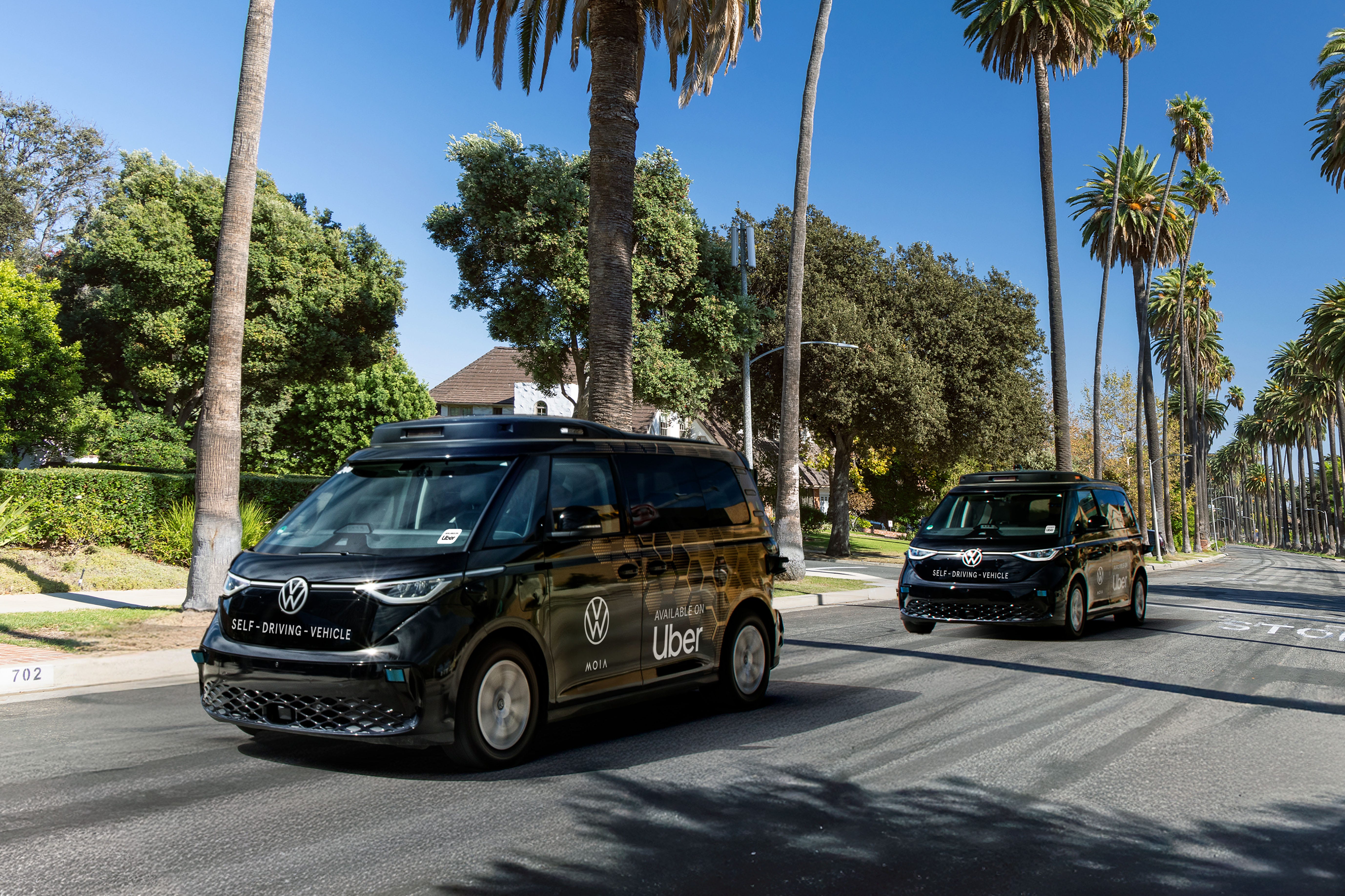
The Volkswagen / MOIA deal is easy to overlook, but it adds another meaningful U.S. lane. Uber and Volkswagen said they plan to deploy a fleet of thousands of autonomous ID. Buzz vehicles across multiple U.S. markets over the next decade, starting in Los Angeles, with testing beginning in late 2025 and commercial launch expected in 2026. This is not as near-term concrete as Nuro / Lucid, but it is another proof point that major OEM-backed AV supply is choosing to plug into Uber rather than build a standalone demand network from scratch.
Zoox: premium U.S. partner, but no disclosed unit count
The Zoox partnership adds another important U.S. AV partner to Uber’s roster. Zoox robotaxis will launch on Uber in Las Vegas this summer and in Los Angeles by mid-2027, while Zoox continues to run its own app in parallel. Strategically, the most interesting part is that this is the first time Zoox has partnered with a third-party platform. So again, this is not about hard unit count. It is about Uber increasingly becoming the distribution layer even for AV developers that once looked likely to stay fully closed and vertically integrated.

Waymo: real U.S. deployment already happening through Uber
Waymo is different from the others because this is not just future intent. Uber and Waymo expanded their partnership to Austin and Atlanta, with Waymo vehicles available only through the Uber app in those markets. The original announcement framed the relationship around a dedicated fleet expected to grow to hundreds of vehicles over time. So this is less about a giant headline number and more about proof that Uber is already integrating live commercial AV supply into its network in major U.S. cities.
Avride: live proof of smaller-scale rollout
Avride is important mainly as evidence of operating cadence. Uber and Avride launched robotaxi rides in Dallas in December 2025, initially across a 9-square-mile service area. This is not a major disclosed fleet-scale announcement, but it does show Uber turning partnerships into real launches rather than just stacking press releases.

May Mobility: meaningful U.S. pipeline below the top tier
May Mobility is not as high-profile as Waymo, Zoox, or Nuro, but the economics matter. Uber and May said May aims to deploy thousands of AVs on the Uber platform over the next few years, starting in Arlington by the end of 2025. That makes it another substantive U.S. supply relationship, especially because it broadens Uber’s partner bench beyond the handful of headline names investors focus on most.

A lot of commentary around AV tends to sloppily bundle “partnerships” together as if they are equal. They are not, some partnerships are real supply, some are geographic options, but Uber increasingly has both.
Why Uber may end up with better AV economics than the AV developers themselves
This is the key point investors should focus on. The biggest challenge in rideshare has always been demand variability. Morning commute is different from midday. Friday night is different from Tuesday afternoon. Airports behave differently than suburbs. Weather, events, and local density all matter. I’ve extensively written about fleet sizing and demand variability in the past:

A pure first-party robotaxi operator has a real utilization problem. Build too much capacity and your assets sit idle off-peak. Build too little and you fail riders at peak. Uber’s hybrid model is structurally better suited to that world.
AVs can be concentrated where autonomy works best and where utilization is highest. Human drivers can still absorb peak overflow, edge cases, bad weather, difficult geographies, or cities where AV supply is not there yet. Uber does not need AVs to replace the whole network. It just needs AVs to improve the mix of the network.
And if Uber can route scarce AV supply into the densest, cleanest, highest-frequency demand pools, it can likely drive materially better utilization than a standalone AV operator trying to build demand market-by-market from scratch. That is what makes Uber so dangerous here.
Waymo is still the current leader, but it may not be the biggest winner economically
To be clear, Waymo deserves the premium perception it has today.
It has the product.
It has the data.
It has the rider base.
It has the regulatory progress.
It has the most scaled operations.

But as the market broadens, Waymo also looks increasingly like a company testing multiple go-to-market paths at once. It has first-party operations in some markets. It has partnered with Uber in Austin and Atlanta. It has partnered with Lyft in Nashville for a 2026 launch. It is also expanding its manufacturing footprint and vehicle platform mix.
That tells me something important: even Waymo appears to recognize that AV scaling is not just about the autonomy stack. It is about matching that stack with the right operational and distribution layer.
In other words, the likely end state may not be one AV company vertically owning everything. It may be an ecosystem. And if that is true, Uber is very well positioned.
Tesla is still more narrative than scaled reality
Tesla remains the company with the most upside in the bull case and the least patience left in the bear case. Yes, Tesla has now started robotaxi rides in Austin without safety monitors in the car. That is real progress, but the broader picture still looks messy.
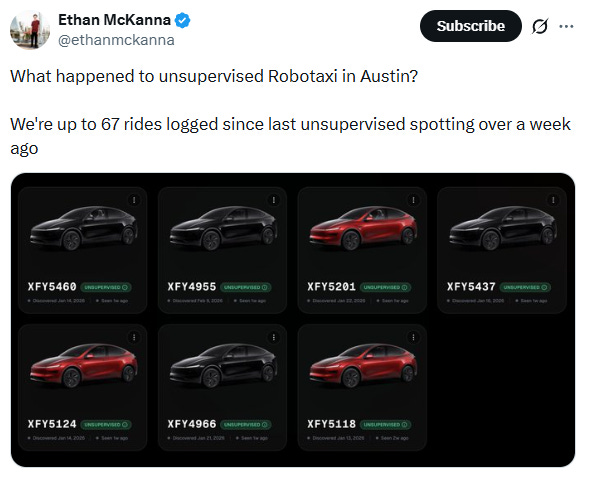
Reuters reported in late February that Tesla logged zero autonomous test miles in California in 2025, the sixth straight year with no such miles reported there, and that the company has not taken the regulatory steps necessary for a commercial robotaxi launch in California. By contrast, Waymo logged over 13 million autonomous test miles before securing its full commercial permissions in the state. That is not a trivial difference. That is the difference between a live commercial system and a story still trying to become one.
At the same time, Tesla’s core auto business is wobbling. Reuters reported this week that analysts increasingly expect Tesla to post a third straight year of declining deliveries in 2026, while capex ramps sharply and concerns about future cash burn rise.
So yes, Tesla still has the biggest theoretical prize if it can crack low-cost, vision-based autonomy at scale. But sitting here today, Tesla looks far less like a clean AV rideshare winner and far more like a company still trying to bridge the gap between product narrative and real commercial deployment.
That is what I mean by floundering. Not dead. Not irrelevant. Just still nowhere near as concrete as the stock and the discourse often imply.
Lyft is in the most awkward strategic position
Lyft deserves some credit for at least making sure it has a seat at the table.
It announced partnerships with May Mobility and Mobileye in late 2024, launched its first May fleet in Atlanta in 2025, partnered with Waymo for Nashville in 2026, and even struck a Baidu partnership for Europe. But compared to Uber, Lyft still looks stuck between identities.
It is not the AV technology leader like Waymo.
It is not the moonshot vertical integration story like Tesla.
And it does not have the same magnitude of disclosed AV pipeline as Uber.
The May Mobility rollout was important, but it did not come with the type of hard fleet scale disclosures that Uber’s Nuro/Lucid tie-up did. The Waymo Nashville deal is meaningful, but it is also incremental rather than market-defining. The Baidu deal is outside the U.S. and does little to change the domestic competitive picture.
So Lyft is not absent. But it is hard to look at the current setup and conclude that Lyft is driving the market structure. It looks much more like a company trying to stay attached to whichever AV suppliers will have it. That is a very different strategic posture than Uber’s.
By the end of 2027, the U.S. AV rideshare map may look completely different
If you zoom out, the likely shape of the market by the end of 2027 is becoming much easier to imagine.
Waymo will probably still be the premium gold standard in actual AV operations.
Tesla may still matter enormously, but it still has to prove it can move from small controlled pilots and repeated promises into scaled, repeatable, regulatorily durable commercial service.
Lyft will likely still participate, but right now it looks more like a follower than a shaper.
Uber is the one increasingly assembling the broadest demand and supply clearinghouse.
That matters because the eventual winner in AV rideshare may not be the company with the single best robotaxi. It may be the company that can best aggregate robotaxis, finance them, route them, fill them, and keep them busy at higher utilization than anyone else.
Today that company looks increasingly like Uber.
And if that is right, then by the end of 2027 the U.S. rideshare market may look much less like Uber vs Lyft and much more like Uber sitting at the center of a hybrid human-plus-AV network, Waymo supplying part of the premium autonomous layer, Tesla still trying to force its own vertically integrated path, and Lyft trying not to get marginalized.
That is a very different market than the one investors were underwriting even a year ago. And in that world, Uber may not need to build the best AV stack. It may just need to become the best place for every AV stack to work.
The obvious risk to this thesis is that if Tesla or Waymo drive vehicle costs low enough, Uber’s utilization advantage matters less than I think.
The information presented in this newsletter is the opinion of the author and does not reflect the view of any other person or entity, including Altimeter Capital Management, LP (”Altimeter”). The information provided is believed to be from reliable sources but no liability is accepted for any inaccuracies. This is for informational purposes and should not be construed as investment advice or an investment recommendation. Past performance is no guarantee of future performance. Altimeter is an investment adviser registered with the U.S. Securities and Exchange Commission. Registration does not imply a certain level of skill or training. Altimeter and its clients trade in public securities and have made and/or may make investments in or investment decisions relating to the companies referenced herein. The views expressed herein are those of the author and not of Altimeter or its clients, which reserve the right to make investment decisions or engage in trading activity that would be (or could be construed as) consistent and/or inconsistent with the views expressed herein.
This post and the information presented are intended for informational purposes only. The views expressed herein are the author’s alone and do not constitute an offer to sell, or a recommendation to purchase, or a solicitation of an offer to buy, any security, nor a recommendation for any investment product or service. While certain information contained herein has been obtained from sources believed to be reliable, neither the author nor any of his employers or their affiliates have independently verified this information, and its accuracy and completeness cannot be guaranteed. Accordingly, no representation or warranty, express or implied, is made as to, and no reliance should be placed on, the fairness, accuracy, timeliness or completeness of this information. The author and all employers and their affiliated persons assume no liability for this information and no obligation to update the information or analysis contained herein in the future.
Great summary. I think Waymo’s model with Lyft in Nashville will be the future: capture first party riders who are willing to pay more and wait longer directly, and use demand aggregators like Lyft and/or Uber to fill in the gaps.
That said, near to medium term, I’d be a bit concerned about Uber’s partnership with Waymo. Waymo has already announced a dozen-plus markets beyond Austin and Atlanta without Uber, which feels pretty telling.
Thanks for this... Just a quick Q if I may...
What do you think Uber's blended take rate on AV rides looks like vs. human-driver rides, and is it durable as partners scale?