


Online travel got nuked this week. Month to date Booking is -21%, Expedia is -18%, and Airbnb is -18%. Meta shipping Muse and the ensuing panic is what everybody is scared of.
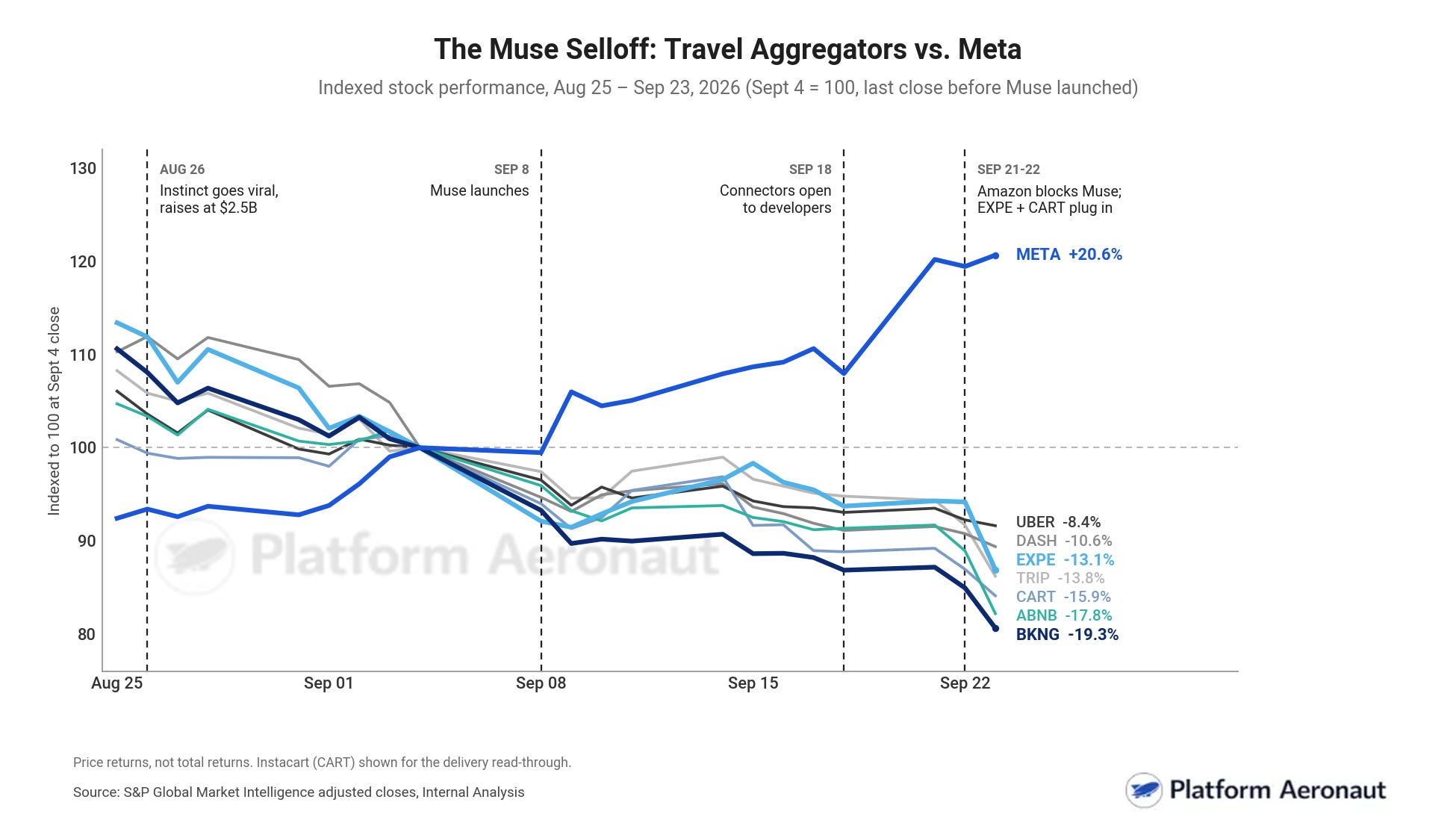
Goldman has been pitching a “consumer inertia” basket post the launch of Muse with a simple but brutal idea: A lot of very profitable companies make money because customers are too busy to shop around, sit on hold, or cancel the thing they forgot they were paying for. As agents like Muse and Instinct get good at price comparison, trip booking, and customer service calls, that inertia stops being a moat.
A year ago I published on the Agentic AI adoption matrix and ran a poll asking when an AI agent would be able to book travel for you end to end.

Only 6% of responders said within 12mo, 39% in 1-2yrs, and 44% said 2-5yrs. Twelve months later Instinct is booking hotel rooms from a text thread and Muse is doing it over WhatsApp. In that same post I wrote that the gatekeepers will likely be the horizontal agent providers that control the consumer entry point and that OTAs would potentially be disintermediated.
But being right about the entry point moving and being right about who loses money are two different things, but the market is shooting first and asking questions later and saying they’re the same thing.
What Muse & Instinct Actually Are (and Aren’t)
Muse launched on Sep 8 as Meta’s first consumer agent running on Muse Spark 1.3 inside a cloud VM. That means it keeps working after you close the app and you can talk to it through a standalone app or through WhatsApp. 3B people already have WhatsApp installed and the flywheel for Meta to drive adoption is enormous. Muse hit 2.5M US downloads in two weeks and passed ChatGPT on the top of the App Store.
Out of the box Muse ships with connectors for a few websites and if a service has a public API it can wire up a connection for you. On Sep 18 they opened connectors to 3P developers and on Sep 22 Expedia, Instacart, Shopify, and PayPal all announced connectors.
The key mechanic for OTAs is that Expedia’s connector is programmatic API access to a defined set of search and booking capabilities. We’re still early and things are still brittle. The reason Muse feels different from ChatGPT with a travel plugin is that it’s the agent, the browser, and the wallet all in one product. A plugin needs the supplier’s permission, but Muse can act on the existing web without anybody’s permission and that’s exactly why Amazon slammed the door shut and why Expedia decided they’d rather offer a clean API.
Why the Market is Calling this Existential
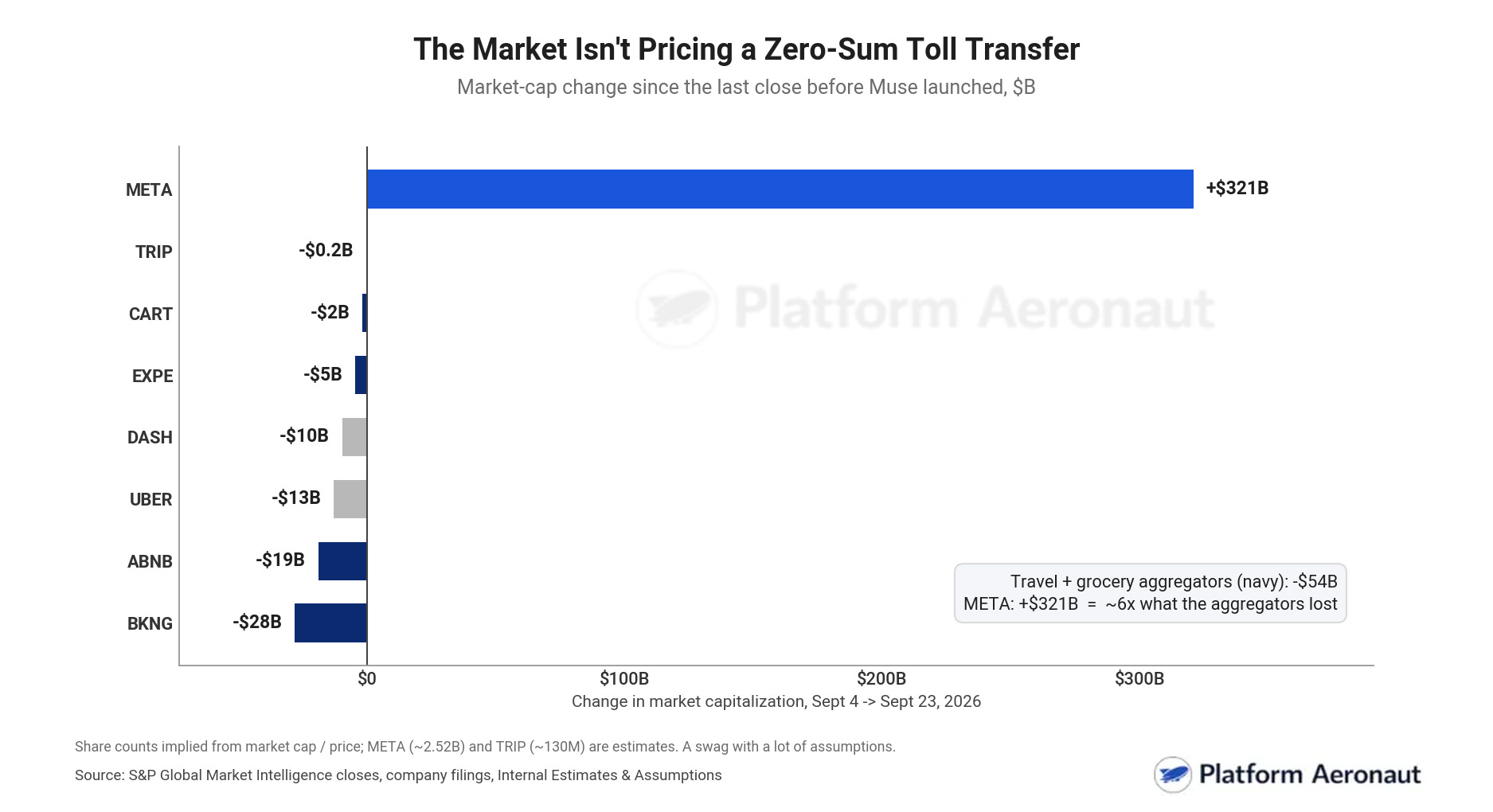
The profit pool is a toll on friction: Booking did $186B of GBV in 2025 and turned it into $27B of revenue (14.5% take rate), $10B of EBITDA and $9B of FCF. That toll exists because finding, comparing, and booking travel across a fragmented hotel supply base is a pain. In an agentic world where agents are explicitly designed to remove that pain what exactly is the OTA take rate for? The market’s crude answer so far: $54B out of the aggregators and $321B into Meta.
New Landlord for the Funnel: Expedia and Booking spend 4-6% of GBV on performance marketing which are big numbers: $8B for Booking alone in 2025. The bulk of that rent goes to Google, but tomorrow some of it will go to Meta or other agents. The landlord is changing from 10 blue link advertising to agents and new landlords tend to renegotiate.
Price Arbitrage Compresses: A meaningful slice of OTA margin comes from consumers not comparing perfectly. Opaque packages, “member” discounts, ad boosters, and varying room type names make it hard to truly compare beyond the lowest price room. An agent whose entire job is to spoon feed you the best option is structurally hostile to all of that.
Suppliers Want Out: Commissions to OTAs for independent and boutique hotels have been stuck at 15-20% for years and chains sit on multiyear master agreements. Hilton, Marriott, and Hyatt already show up more in AI traffic than the OTAs do and they’re actively all investing in their own tech stacks. Put yourself in a hotel GMs shoes: would you rather pay Booking 15% or pay an agent 5%?
Amazon’s Block is a Tell: On Sep 21 Amazon cut Muse off from shopping on the website citing privacy and security. But really it’s about their $20B per quarter advertising business that’s focused on human browsing. If the company with the most logistics, the most supply, and the most customer trust is scared of an agent, an OTA should be terrified.
Who is the Most Exposed? Metasearch and lead-gen get routed around first (Tripadvisor is -14% since the launch). Next is Expedia’s consumer business with a heavy chain and air mix. Then Booking, and last Airbnb.
The market isn’t wrong that the entry point is moving, but the sell-off right now is really a bet that “too lazy to shop around” was a trillion dollar moat and that agents are laziness-as-a-service.
Steelman: Why it’s a Channel, Not a Replacement (Yet)
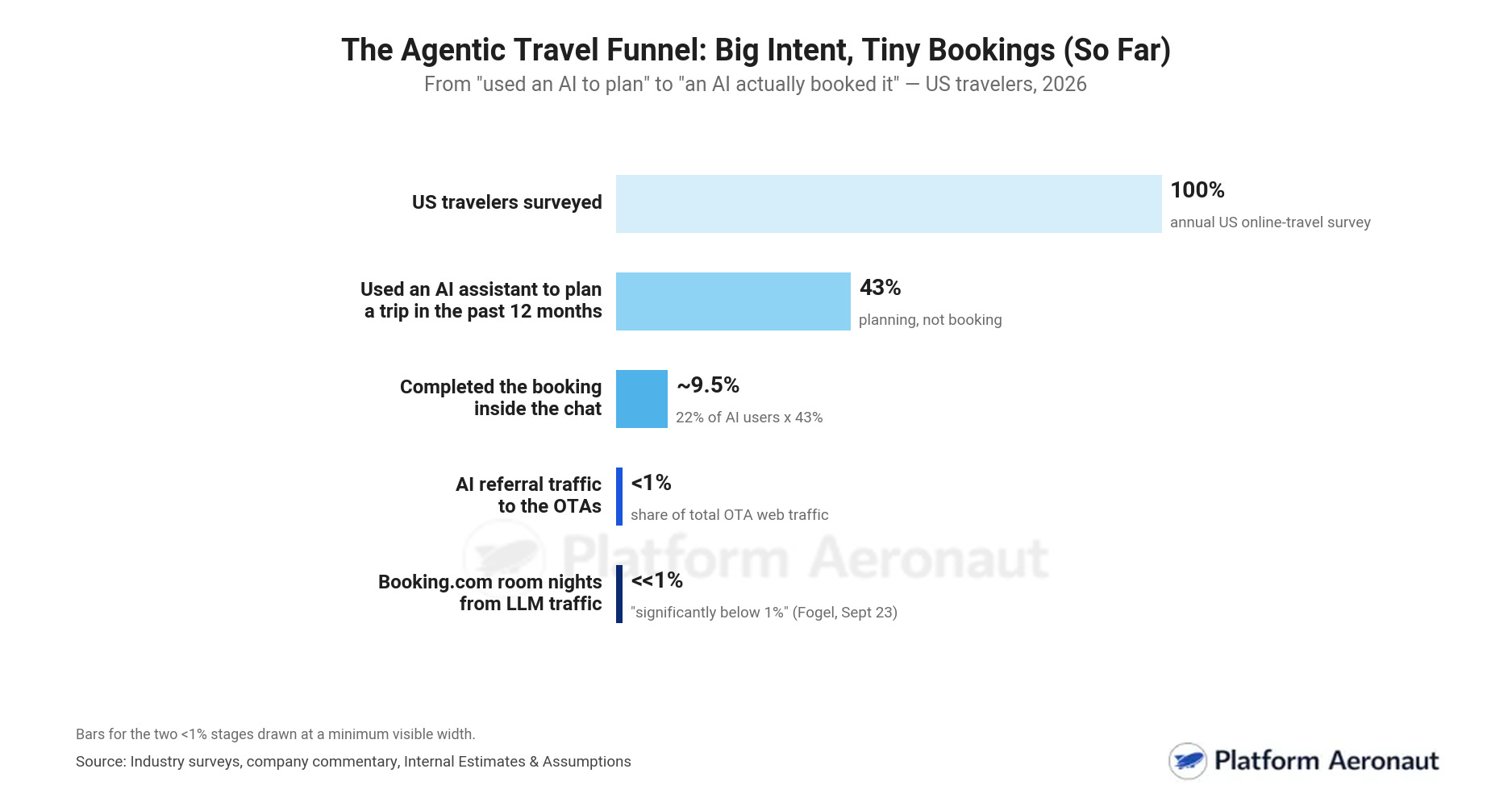
Actual Usage is a Rounding Error: AI referral traffic is under 1% of OTA traffic and Booking CEO Glenn Fogel said it’s “significantly below 1%” of Booking’s roomnights. A recent survey said 43% of US travelers used an AI assistant to plan a trip but only 22% of those actually booked in chat which means 3/4 of AI planners still finish the booking somewhere else.
The Agents Route Through the OTAs: Test Muse or Instinct on a hotel and they mostly land on Booking or Expedia unless you explicitly ask for direct pricing. Google’s AI Mode hotel booking keeps the OTA as the merchant of record. Right now these agents are free traffic.
Fragmented Supply is the Moat: Booking has 4.7M properties and independents supply the vast majority of its roomnights. An agent can connect to Marriott or Hyatt once, it cannot contract with, pay, and service millions of independents in 200 countries. Companies like Mews are helping the independent world catch up on digitalization, but we’re not quite there yet.
Payments and Servicing are Hard: Booking’s merchant mix is 73% of GBV. They hold the money, issue virtual cards, eat the fraud, and answer the customer service issues. Google has repeatedly refused to become the merchant of record for 15 years because bookings dilute ad margins and it’s complicated. Sometimes the customer wants one source of trust for a booking, not relying on an agent to deal directly with a bed and breakfast owner in the Dolomites.
Loyalty is Real: Booking’s Genius Level 2 and 3 members are over 30% of active customers and high 50% share of room nights with plenty of hotel funded discounts. It’s not impenetrable but it’s somewhat of a moat. It highly depends on what roomnights are hit first. If agents route direct, hotels will fund their own member rates instead and Genius becomes a lot less powerful as a moat.
Nobody’s moat was ever the search box. It was supply aggregation and contracts/payment rails/rebooking. Muse has touched the front door which is worth something.
Unit Economics: $1,000 Hotel Booking
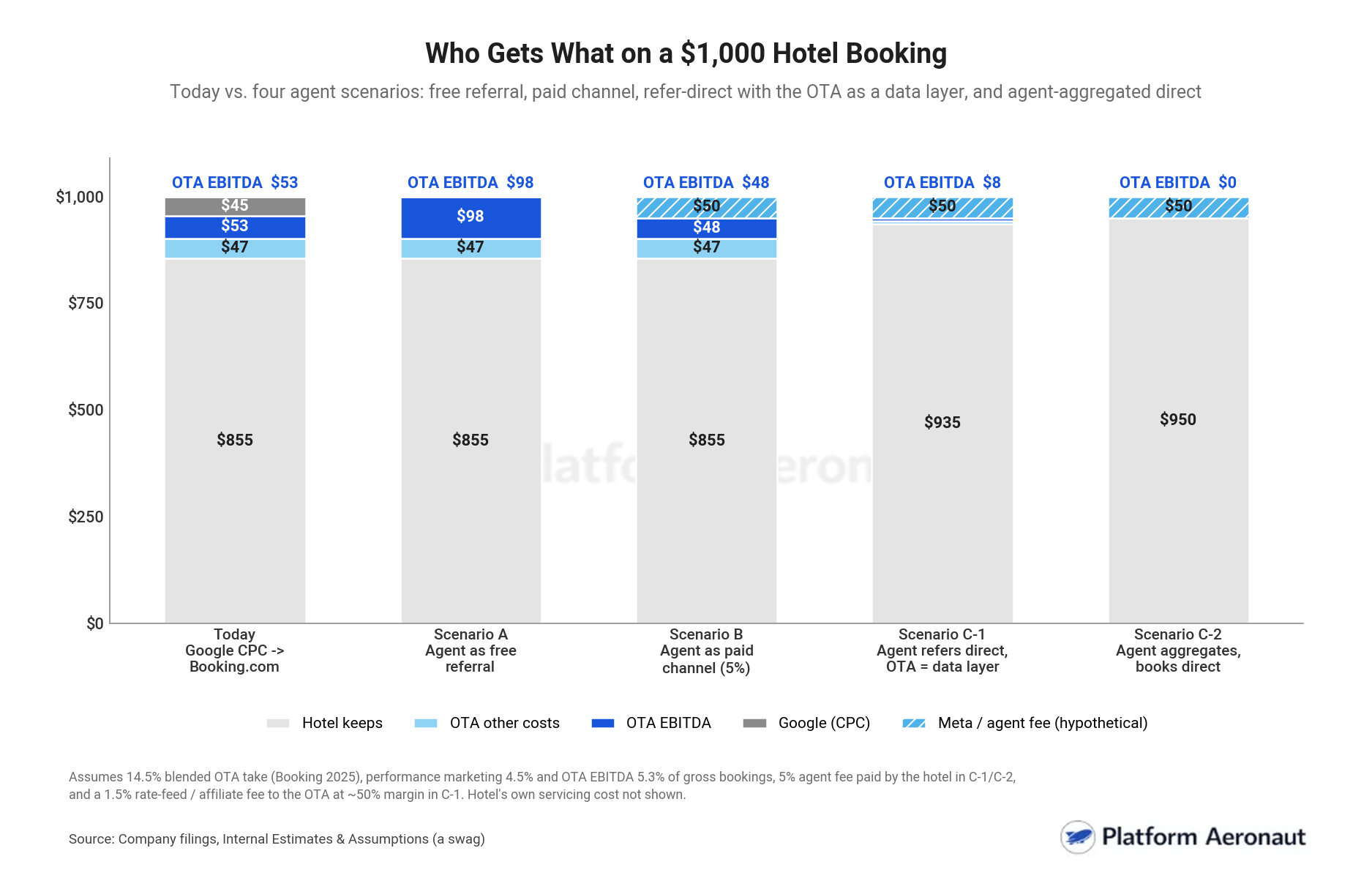
Today Booking earns $145 on a $1,000 hotel booking, spends $45 on performance marketing and keeps $53 of EBITDA. Let’s explore some scenarios for how things could go:
Scenario A: Agent as Free Referral. Muse sends the traveler to Booking and charges nothing (which is what it is today). If it replaces a Google click, marketing spend goes to $0 and EBITDA goes from $53 to $98. This is unlikely to be the end state, but it could be the reality in the short term as Meta and competitors are focused on consumer mindshare, not monetization.
Scenario B: Agents as Paid Channel. Say Meta charges 4-6% referral fee or $40-60. It’s essentially a 1:1 swap from Google Spend and EBITDA goes to $48. This is a change of landlord, not a change of business. But if this is incremental spend though it’s a real margin hit to the OTA.
Scenario C-1: Agent Goes Direct, OTA Becomes the Data Layer: An agent doesn’t need to aggregate supply, hold the money or answer the phone. It just points the traveler to the hotel’s own booking engine and the hotel takes payment and the burden of servicing. The OTA can still aggregate supply as a B2B data layer but that’s not a great business model. At a 1-2% fee thats $8 of EBITDA per booking, not $53. This is the scenario the market is pricing and it requires nothing new from Meta.
I’ll caveat that Expedia’s B2B business today results in solid margins, this Scenario C-1 is when the hotel’s own engine is the source of truth and the OTA is only selling rate data in which case B2B is not nearly as attractive.
Scenario C-2: Agent Goes Direct to Hotel & Aggregates. OTA is nuked and the hotel keeps $950 instead of $855. This is the truly existential threat to OTAs where they don’t even collect a data toll, but it requires the agent to aggregate supply and that’s a job every prior demand aggregator has declined.
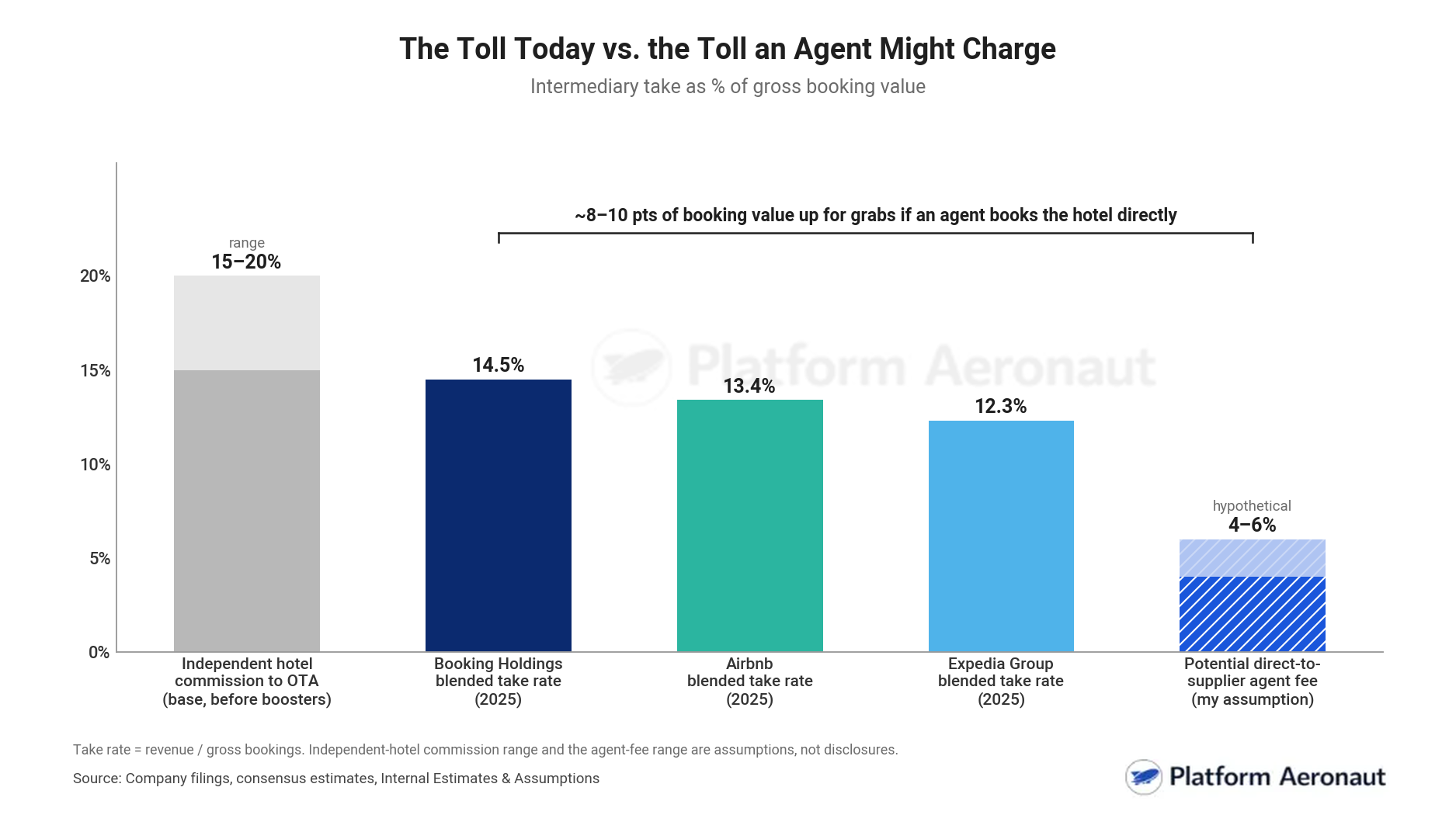
The market is starting to price in Scenario C-1 while the first stop on the train is more like Scenario A moving towards Scenario B.
Expedia vs Booking vs Airbnb: Not the Same Exposure
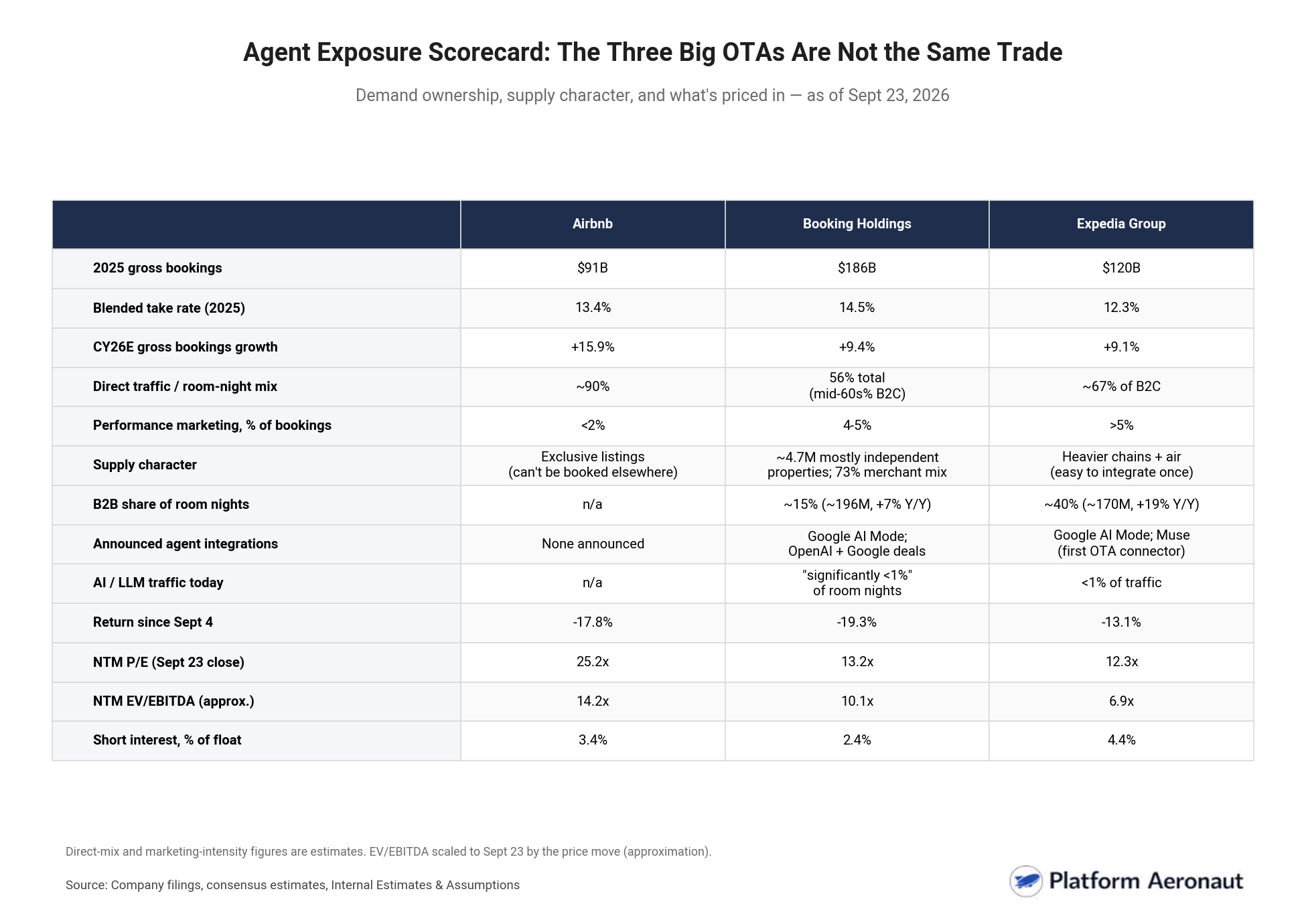
Direct traffic mix differs materially between the players: Airbnb is 90%, Booking and Expedia are mid 60% depending on B2C vs B2B definitions. One short hand is that performance marketing tells you how much P&L is exposed to a landlord change. Under 2% of bookings at ABNB and 4-5% at BKNG and >5% at EXPE is up for shifting.
The real differentiator is supply type. Booking has significant exposure to fragmented independents, Expedia is heavier on chains and air, and Airbnb has mostly exclusive listings that can’t be sourced elsewhere.
One wildcard for Booking is in Europe: DMA compliance stripped maps and price filters out of Google Travel in Europe and is pushing organic traffic back to the OTAs, Muse is US-only for now, and a huge chunk of Booking's business is European.
One big component of Expedia’s business in B2B which provides some insulation (for now). It’s 40% of room nights growing 19%. You could make the argument that an agent that needs supply is just another B2B partner alongside the 70,000 others that Expedia has.
Expedia’s Bet: Become the Rails
Among the OTAs, Expedia has the most explicit strategy of SEO → OTA → MCP. They have Rapid API and white-label deals already powering airline and bank portals. There are MCP servers exposed to ChatGPT and Google’s commerce protocol. The bullish read is that B2B is the fastest growing most defensible segment. The negative reads is that it’s lower quality, doesn’t build the brand or own the relationship, and if Meta ends up owning the traveler then Expedia just becomes a low-margin fulfillment business like what happened to the GDS companies.
On the Q2 call CEO Ariane Gorin said:
“We're introducing these natural language experiences like Vrbo natural language search on the homepage, or these agents like Property Expert or AI Compare. Those are not driving conversion right now, but what we're finding is that you get over 60% more information about traveler intent.”
If Expedia keeps merchant of record inside Muse or Instinct as it does with Google, it owns payments, servicing, and data. If the agent takes it, then Expedia is just a wholesale feed.

Final Thoughts
The entry point is moving from search box to agent permanently. Supply contracts, payment rails, and servicing have to be completed somewhere. In theory the agent hands all of that to the hotel (Scenario C-1) and the math on that is sobering: if one in six bookings that runs through an OTA today goes direct to the hotel over the next 5 years, OTA roomnight growth goes from 5% consensus to roughly flat with the travel market overall still growing.
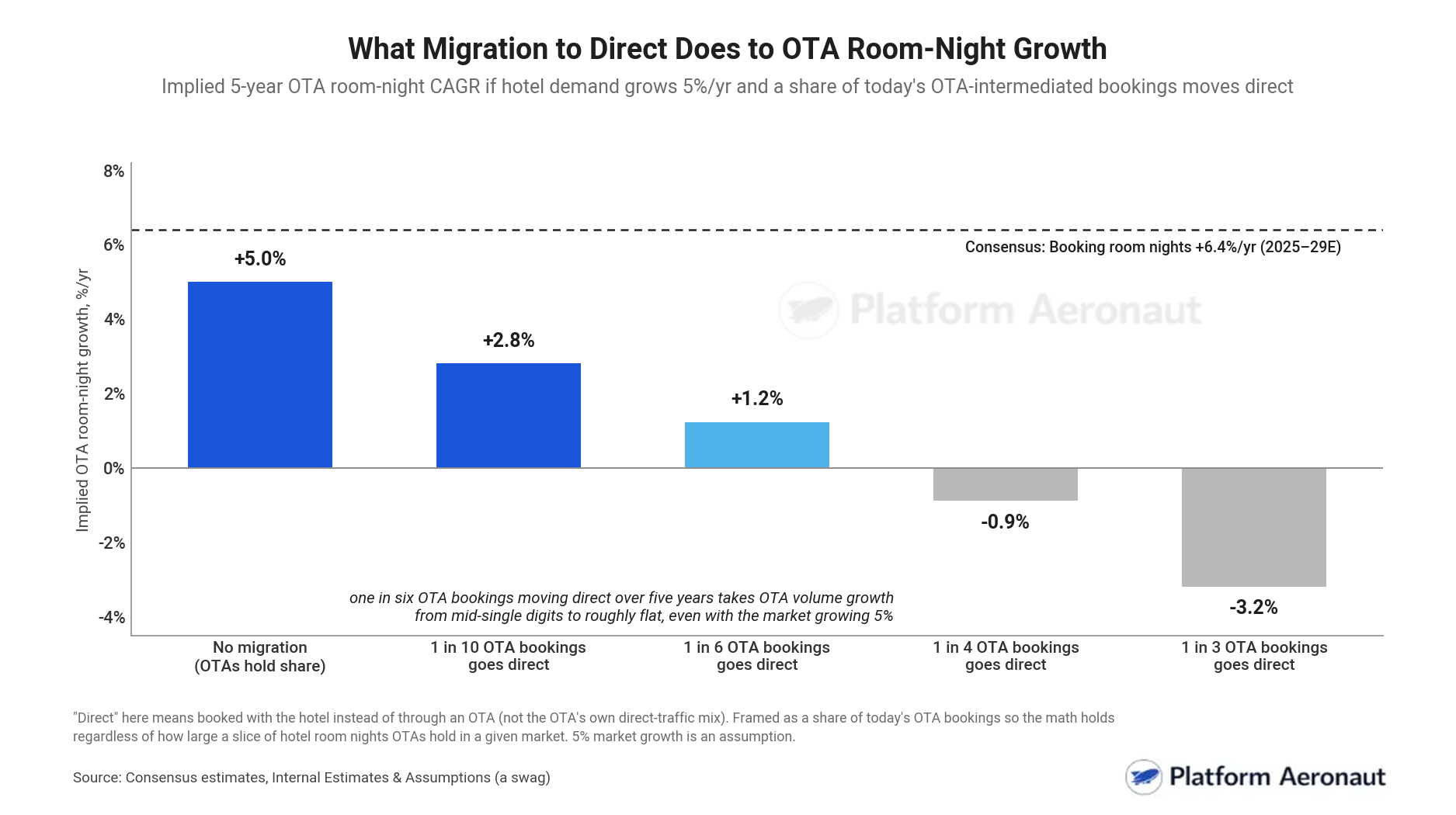
Scenario C-1 doesn't require Meta to become an OTA. It just requires hotels to become bookable, and that clock is already running. Meta and agents will bring the demand and PMS vendors like Mews are bringing the supply online. I think it's a multi-year fight over exactly the migration in the chart above, fought hardest in the fragmented, cross-border supply that Booking happens to own the most of. The gap between what's priced and what's actually happened is the whole debate. Muse is a distribution shock priced as a supply shock.
The information presented in this newsletter is the opinion of the author and does not reflect the view of any other person or entity, including Altimeter Capital Management, LP (”Altimeter”). The information provided is believed to be from reliable sources but no liability is accepted for any inaccuracies. This is for informational purposes and should not be construed as investment advice or an investment recommendation. Past performance is no guarantee of future performance. Altimeter is an investment adviser registered with the U.S. Securities and Exchange Commission. Registration does not imply a certain level of skill or training. Altimeter and its clients trade in public securities and have made and/or may make investments in or investment decisions relating to the companies referenced herein. The views expressed herein are those of the author and not of Altimeter or its clients, which reserve the right to make investment decisions or engage in trading activity that would be (or could be construed as) consistent and/or inconsistent with the views expressed herein.
This post and the information presented are intended for informational purposes only. The views expressed herein are the author’s alone and do not constitute an offer to sell, or a recommendation to purchase, or a solicitation of an offer to buy, any security, nor a recommendation for any investment product or service. While certain information contained herein has been obtained from sources believed to be reliable, neither the author nor any of his employers or their affiliates have independently verified this information, and its accuracy and completeness cannot be guaranteed. Accordingly, no representation or warranty, express or implied, is made as to, and no reliance should be placed on, the fairness, accuracy, timeliness or completeness of this information. The author and all employers and their affiliated persons assume no liability for this information and no obligation to update the information or analysis contained herein in the future.