


Every robotaxi post hits the same wall of needing an accurate total fleet number and an ability to track. Robotaxi Tracker and The Charge Port and FSD DB do a good job of crowdsourcing or scanning the TX DMV website, but I needed to cross reference every news release, research, and press release out there in combination with the TX DMV and CA CPUC records to get an accurate picture.

5,574 Autonomous Vehicles Operating in the US
The end result of this is a new AV Tracker that currently sits at 5,574 autonomous vehicles across the United States with Waymo accounting for 76% of them.

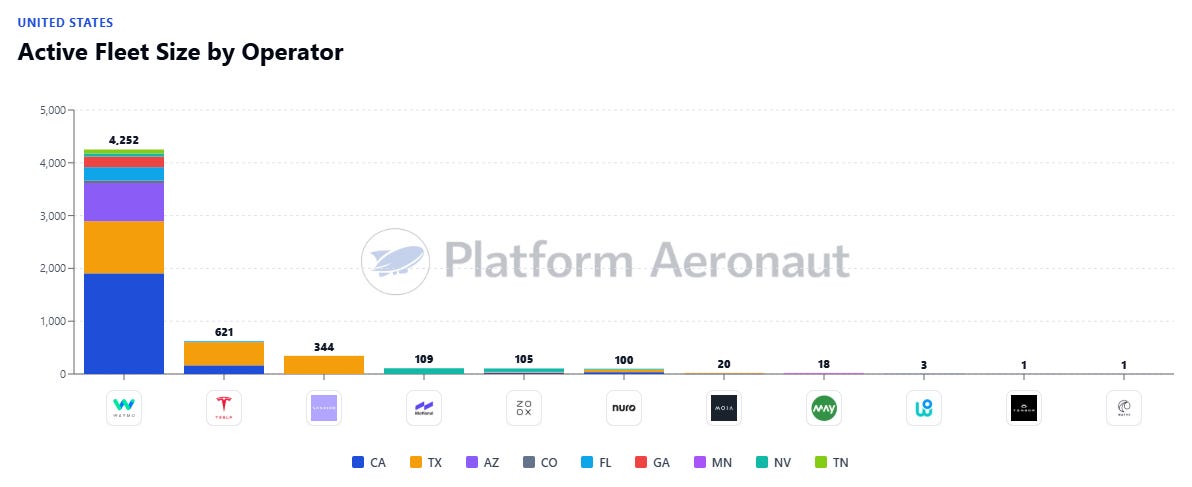
I’ll caveat that the numbers aren’t perfect as they often include test vehicles, or driver/monitor vehicles or vehicles registered but not yet in use or deployed, but it’s my best attempt at the most accurate picture of the current total US fleet (and it should update as more news and VIN registrations flow in automatically).
Texas is the real story
California still leads at 2,153, but Texas is right behind at 1,896, within 13%. More important, it's the only state with a VIN-level public registry. Under SB 2807 you need a TxDMV authorization and have to list every car on it. Texas is also going to be a dog fight between Waymo, Tesla, and Uber (Avride and Nuro) so it’s a good market to keep an eye on.

CPUC Data for CA in One Place
The other big piece that has been annoying is consolidating CPUC data for Waymo in California in one location. I cleaned it all as best I could and put it up on the California Tracker page.

The data is all through Q2 2026 and is really only for Waymo as they’re the only operator in deployment mode. We’ll get a good Q3 update that should start to show more pilot data for Nuro and others later in the year.
AV News Feed
I also have an auto-crawler that pulls AV related news into a feed that helps inform fleet count numbers. It’s searchable and links out directly to the sources. I figured transparency is helpful here.

Obviously if you notice anything amiss or numbers are clearly wrong don’t hesitate to reach out. This isn’t going to be a perfect science as most operators are very protective of fleet count numbers and performance and do a lot to obfuscate fleet numbers.
Map with Fleet per Capita

One thing I thought was worth doing was doing a map with Fleet per Population. Essentially it’s how many vehicles are there per 100k people. It’s early days so it’s not indicative of much really, but at some point in the next 12-24 months when we have thousands more vehicles on the road we’ll start to see the density here take off.
Performance & Valuation Snapshot
Note: Email renders these as images, click through for interactive filters or view on Platform Aeronaut.
What I Read This Week
Meta launches Muse with real travel-booking capabilities: Meta’s new personal AI agent can search, book and service flights using Duffel’s infrastructure or transact directly on airline sites, one of the clearest examples yet of a general-purpose agent becoming a travel intermediary.
U.S. regulator presses Tesla over Cybercab certification: NHTSA has ordered Tesla to answer questions by Sept. 30 about how Cybercab was certified, including its use of temporary human controls, an important regulatory hurdle as Tesla attempts to commercialize a vehicle built without conventional driver controls.
Expedia says answer-engine optimization is its fastest-growing channel: CEO Ariane Gorin says Expedia is actively investing in AEO, horizontal AI agents and paid AI distribution; natural-language searches also provide Expedia roughly 60% more traveler-intent data than conventional searches.
Waymo is bringing commercial autonomous ride-hailing to Las Vegas: Las Vegas becomes another major expansion market for Waymo and potentially an especially important test of airport, tourism and hospitality-related robotaxi demand.
Walmart expands further into restaurant delivery with Dunkin’: Walmart is using its existing last-mile network to move beyond grocery and general merchandise into prepared-food delivery, increasing competitive overlap with DoorDash and Uber Eats and illustrating how large logistics networks can become multi-category commerce platforms.
Travel companies are reallocating tech budgets toward AI: PhocusWire reports companies are shifting capital away from traditional SaaS and outsourced development toward AI, suggesting AI is increasingly replacing not merely supplementing parts of the travel-tech stack.
Transcript Highlights

Adobe (ADBE) Q3 2026 Earnings Call
Adobe stated it has not committed to a single monetization model for AI and will use a mix of freemium conversion, credit packs, premium tiers, per-seat pricing, and usage-based models depending on customer context.
Adobe framed a company-wide shift to ‘agentic’ software covering creativity, productivity, and customer experience, positioning AI as a core product platform rather than a point feature.
The company reported that it doubled the number of paid customers quarter-over-quarter for brand visibility solutions, indicating faster commercial adoption of that product bundle.
Broadcom (AVGO) Q3 2026 Earnings Call
A long-term agreement with Google was announced to develop and supply future generations of TPUs and AI networking, with planned deliveries described as multi-tens of billions of dollars annually.
Leading-edge wafer supply, substrates, and HBM memory were identified as potential supply bottlenecks referenced repeatedly on the call.
Laser and optical component capacity (EML, Vixels, CW lasers) is being expanded with phosphide factories more than tripling year-on-year to meet optical interconnect demand.
Snowflake (SNOW) Q2 2026 Earnings Call
Customers are expanding through migrations and AI use cases, with internal examples showing faster migrations and increased production workload counts.
AI activation is reported to drive higher platform consumption, with customers using AI consuming more across the data platform.
The CFO stated two key goals: deliver growth with margin expansion and support go-to-market excellence, implying capital prioritization toward growth and efficiency.
The information presented in this newsletter is the opinion of the author and does not reflect the view of any other person or entity, including Altimeter Capital Management, LP (”Altimeter”). The information provided is believed to be from reliable sources but no liability is accepted for any inaccuracies. This is for informational purposes and should not be construed as investment advice or an investment recommendation. Past performance is no guarantee of future performance. Altimeter is an investment adviser registered with the U.S. Securities and Exchange Commission. Registration does not imply a certain level of skill or training. Altimeter and its clients trade in public securities and have made and/or may make investments in or investment decisions relating to the companies referenced herein. The views expressed herein are those of the author and not of Altimeter or its clients, which reserve the right to make investment decisions or engage in trading activity that would be (or could be construed as) consistent and/or inconsistent with the views expressed herein.
This post and the information presented are intended for informational purposes only. The views expressed herein are the author’s alone and do not constitute an offer to sell, or a recommendation to purchase, or a solicitation of an offer to buy, any security, nor a recommendation for any investment product or service. While certain information contained herein has been obtained from sources believed to be reliable, neither the author nor any of his employers or their affiliates have independently verified this information, and its accuracy and completeness cannot be guaranteed. Accordingly, no representation or warranty, express or implied, is made as to, and no reliance should be placed on, the fairness, accuracy, timeliness or completeness of this information. The author and all employers and their affiliated persons assume no liability for this information and no obligation to update the information or analysis contained herein in the future.